
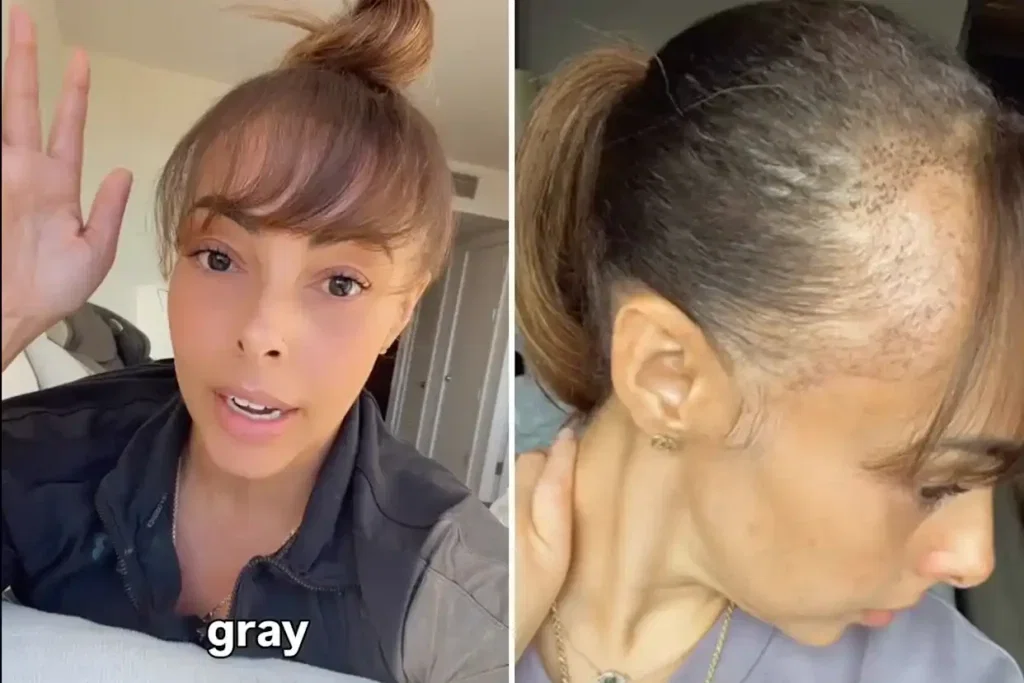
A recent case out of Los Angeles is drawing attention across the hair restoration community after a patient experienced a highly unusual complication: hair at and around her transplant site began growing in gray shortly after surgery, even though she had almost no gray hair prior to the procedure.
The Patient and the Procedure
Nini B, a nurse and content creator based in Los Angeles, chose to undergo hairline-lowering surgery in February 2026 to bring her hairline down and better frame her face. Before committing to a surgical route, she had experimented with several non-invasive treatments — including exosome therapy, red light therapy, and microneedling — but none delivered the results she was hoping for.
Her surgeon, Dr. Robert Drummond of Crown Hair Institute in Beverly Hills, harvested 2,500 grafts from the donor area at the back of her scalp and transplanted them to construct a lower, softer hairline.
Cosmetically, the outcome met her expectations. She has said publicly that she’s pleased with the shape and framing the procedure achieved. But something unexpected began to appear during recovery.
An Unprecedented Outcome
Roughly two to three weeks into healing, Nini noticed that new hair emerging from both the transplant site and the tissue immediately surrounding it was coming in gray. The depigmentation wasn’t limited to the newly placed grafts — it extended into areas of her scalp that hadn’t been surgically touched.
The side effect is uncommon enough that it wasn’t part of her pre-operative risk discussion. According to Dr. Drummond, he has performed hundreds of transplants without ever seeing this outcome, and his lead technician — who has more than two decades of experience and over 5,000 procedures to her name — has never encountered it either. The case may be documented in medical literature as a formal case study.
What Might Be Causing It?
Published research on post-transplant depigmentation is sparse, but Dr. Drummond offered some working theories. Gray hair can emerge for many reasons, including genetics, environment, diet, and physiological stress. He pointed to shock loss as a likely contributing factor — a recognized post-transplant phenomenon in which follicles near a surgical site temporarily enter a resting phase due to trauma in the surrounding tissue.
Shock loss typically causes transient shedding rather than pigment changes. In Nini’s case, however, it appears her scalp had a more pronounced reaction than usual, producing shock loss in both the donor and recipient areas and, seemingly, affecting melanocyte activity in the regrowing hair. Whether her original color will return remains uncertain. She has reported some improvement in the donor area, while the recipient site remains depigmented for now.
Takeaways for Prospective Patients
Nini’s experience is a useful reminder that even well-established cosmetic procedures can produce rare outcomes that don’t appear in standard informed-consent conversations. Hair transplantation has a strong overall safety profile, but individual biology introduces a degree of unpredictability into any surgical intervention.
For anyone weighing a procedure, this case reinforces a few practical points: work with an experienced surgical team that documents outcomes transparently, understand standard risks like shock loss and temporary shedding, and set realistic expectations for a recovery window that can span several months before the final result becomes clear.