
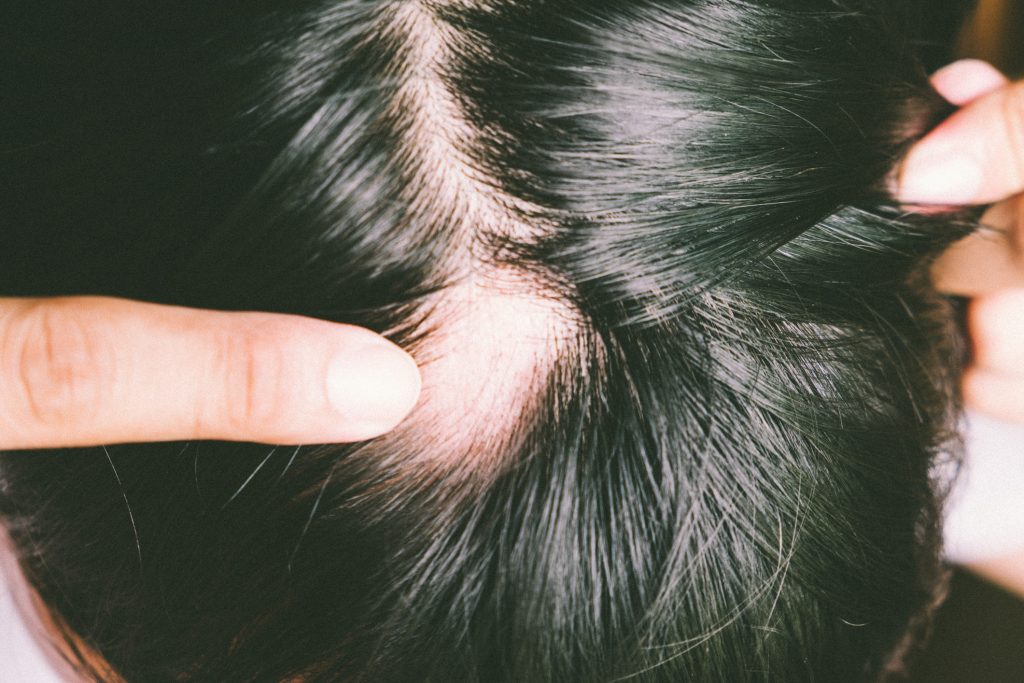
Type “how many grafts do I need?” into a search bar and you’ll get a list of tools promising you an answer. Clinic sites, directories and app stores all offer graft calculators, most advertising an AI engine. One Google Play listing promises modeling that adapts to your case instead of using “a flat lookup table,” and likens its logic to a surgeon’s. Others add per-region estimates and donor visualizers.
The appeal is obvious: hair transplant surgery is expensive, quotes vary wildly, and patients want a number of their own before a sales pitch. Some tools ask you to pick a Norwood diagram. Others ask for photos, which feels closer to a real assessment. Either way the number you’re given is based on far less than it appears to, and patients are carrying it into consultations to judge which clinic is being honest.
The input is already unreliable
Almost every calculator starts from a self-reported Norwood-Hamilton stage, a scale that is widely used but very limited. When seven dermatologists and sixteen residents classified 43 photographs of male scalps, agreement between raters reached an intraclass correlation coefficient of only 0.63 to 0.68, and repeatability three months later was poor.
Translation: even medical professionals commonly disagree about Norwood-Hamilton and might not select a stage consistently between the same patient seen at different times.
The authors of the study itself called it unsatisfactory even among expert appraisers (Guarrera et al., 2009) and it raises the question: if trained dermatologists disagree with each other and with themselves, how useful is it for a a patient to try to determine their own Norwood-Hamilton stage?
What a photo can and can’t show
Photos go a bit further and do show something: how far the hairline has moved and how wide the thinning area is. That’s the demand side, and a phone camera handles it well enough. Supply is the harder half. It lives in the donor area — follicular unit density, hairs per unit, hair caliber, contrast against the scalp, miniaturization, scalp laxity — and estimating those takes magnification. None of this shows up in a photo taken at arm’s length, and a graft number needs both halves.
A study of occipital donor scalp found 65 to 85 follicular units per square centimeter and 124 to 200 hairs per square centimeter (Jimenez & Ruifernández, 1999) — nearly a twofold spread in the raw material. A separate FUE study found graft-to-hair ratios of 1:1.65 to 1:2.75 across ten patients (Effect of Follicular Unit Extraction on the Donor Area, 2018).
What this means: two men at the same Norwood stage can need very different numbers for the same result, and no app that hasn’t measured their scalps can tell them apart.
“Graft” is not a fixed unit
A graft count alone doesn’t tell you how much hair you’re getting. A graft is a follicular unit, and follicular units hold one to four hairs. A clinic can inflate a quoted number by splitting multi-hair units into smaller ones — more grafts, no more hair. That’s why experienced surgeons tell patients to ask about average hairs per graft.
There is no right answer for a model to learn
Machine learning that works for hair looks nothing like a consumer app. A 2025 Korean study trained a model to spot early androgenetic alopecia on 318 magnified scalp images from clinical dermoscopy equipment, then tested it on 20 it had never seen (Ewha Womans University Medical Center, 2025). Systems like this grade how advanced the loss is. They don’t plan surgery.
Software learns from thousands of examples with the answer attached. A graft recommendation has no answer to attach. It trades covering more scalp against packing hair more densely, judged against a guess at future loss and a lifetime donor supply usually put at 4,000 to 6,000 grafts. Two surgeons can reach different numbers and both be right, because the better plan depends on what the patient wants.
Nobody has checked the claims
These calculators publish no test results at all. The nearest comparison is discouraging: a BMJ review of smartphone apps assessing skin cancer risk found they can’t be relied on to catch every melanoma, that real-world performance is likely worse than published figures, and that CE marking doesn’t adequately protect the public (Freeman et al., 2020). In the US, the FDA applies enforcement discretion to software it deems low-risk, so nobody reviews it before release, and a cosmetic estimator sold as informational draws little scrutiny.
The accuracy figures these pages quote are largely invented. One clinic’s calculator claims online tools are 40-60% accurate against 90-95% for a consultation, citing nothing for either.
What they are actually for
At best, a graft calculator gives you a very rough number pointing in the right direction. That’s as good as it gets. And whether you found it on a clinic’s website or a third-party directory, it exists for basically one reason: to encourage you to submit inquiry. The number is the hook. Some calculators are more candid than others about how rough the estimates are, which counts for something, but it doesn’t change what the number is for.
A rough number is still useful. It tells you whether you’re looking at closer to 1,500 grafts or 4,500 grafts, and gives you knowledge about terms to bring to a consultation. What it can’t do is the part that decides your result.
Nothing on a screen replaces what it imitates. The only way to find out how many grafts you need is to put your scalp in front of a qualified surgeon: someone whose credentials and license you can verify, who measures your donor area with a densitometer, who performs the surgery rather than handing it to technicians, and who talks to you in hairs rather than graft totals. That consultation is the real measurement and estimate. Everything before it should be treated as a guess.
So if you use a graft calculator, use the number it gives you as a starting point and let it give you better questions to bring into a consultation. How many hairs is that? How much donor supply is left afterward? What happens when the hair behind the transplanted zone keeps thinning? Ask them of a surgeon you’ve checked out, in a room where someone is looking at your actual head.