
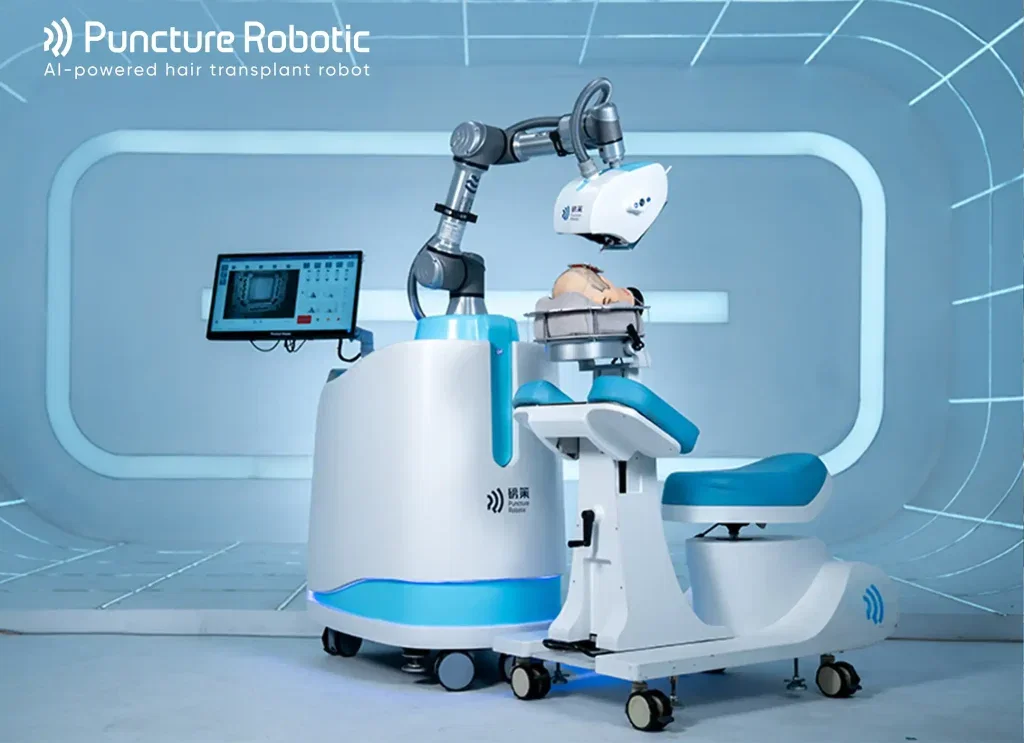
Robotic hair restoration took another step forward this month at the 14th World Congress for Hair Research (WCHR 2026), where Seoul-based Puncture Robotic drew international attention with the debut of HAIRO, its AI-powered hair transplant robot. The company is positioning HAIRO as an end-to-end robotic platform for hair restoration and, notably, as the first hair transplant robot to earn China’s NMPA Class III certification, the country’s highest medical device classification.
What HAIRO Actually Does
Unlike devices that automate a single step of surgery, Puncture Robotic says HAIRO is designed to span the full hair restoration workflow. The ecosystem starts before a patient ever reaches the operating room: an intelligent detection device assesses and classifies the degree of hair loss, and an AI application generates personalized simulations so patients can visualize what their post-transplant result might look like.
During surgery, the system supports the physician with AI-assisted preoperative planning and real-time adjustments. A machine-learning algorithm continuously analyzes data gathered during follicular unit extraction (FUE) and adapts its operating parameters to each patient’s follicle structure and scalp characteristics.
The hardware specifications are what turned heads at the congress. HAIRO pairs 20-megapixel binocular cameras with image processing measured in milliseconds, which the company says enables sub-surface positioning accuracy down to 0.1 mm. The robot can process up to 2,400 follicles per hour using extraction needles between 0.7 mm and 1.0 mm, notably finer than the punches used by some earlier robotic platforms. This is a factor that matters for donor-area scarring and healing.
Perhaps the most interesting piece of the technology is what Puncture Robotic calls its “Single-Hair Skipping” algorithm. The system identifies follicular units containing multiple hairs and prioritizes them for extraction, selectively passing over single-hair units when appropriate. According to company data, this yields a multi-hair extraction rate of up to 95%. For patients, the practical implication is potentially greater visual density from fewer grafts, meaning less depletion of the finite donor area. The company also reports a follicular unit damage rate below 7.5% under specified operating conditions.
Puncture Robotic emphasized that HAIRO is intended to assist surgeons rather than replace them, handling the repetitive, precision-intensive stages of the procedure so physicians can concentrate on hairline design, aesthetics, and patient care. Dr. Guanzhou Zhu, founder of DCDC Hair Transplant Hospital in Taiwan, remarked at the event that the system’s speed, stability, and ultra-fine needle capability show its potential as a clinical partner for experienced surgeons.
The company also previewed a long-hair extraction version of HAIRO in development, which would allow FUE without fully shaving the donor area, a frequent request from patients who want a discreet procedure and recovery. Backed by a recent multi-million-dollar Series B round led by a major AI technology company, Puncture Robotic says it is now pursuing FDA clearance and CE certification as it eyes international expansion.
How HAIRO Fits Into the Robotic Hair Transplant Market
HAIRO enters a field that, until recently, has been defined largely by one name: ARTAS. Introduced by Restoration Robotics and now marketed by Venus Concept, the ARTAS system pioneered image-guided robotic FUE, using AI algorithms and a robotic arm to select and dissect follicular units. Its latest generation, the ARTAS iX, extended automation to recipient-site creation and graft implantation. ARTAS holds FDA clearance and CE marking, but it comes with well-documented limitations: it is indicated for patients with straight brown or black hair (lighter or gray hair typically must be dyed before surgery), and some surgeons have criticized the relatively larger punch sizes of earlier models as a scarring concern.
Beyond ARTAS, patients researching “robotic” hair transplants will encounter a spectrum of technologies that vary widely in how much automation is actually involved. Systems such as the HARRTS FUEsion X combine AI follicle analysis, augmented reality guidance, and automated handheld extraction, while keeping the surgeon’s hands on the instruments. NeoGraft and SmartGraft, though often marketed alongside robotic options, are semi-automated suction-assisted handheld devices rather than true robots. HAIRO’s claims — full robotic extraction with 0.7 mm needles, real-time adaptive algorithms, and intelligent graft selection — place it squarely in competition with ARTAS at the fully robotic end of that spectrum, while its selective multi-hair extraction approach is a genuinely distinctive feature.
For context on the numbers: HAIRO’s stated throughput of up to 2,400 follicles per hour would, if borne out in routine clinical use, be fast by industry standards, where a typical FUE session harvests 2,000–3,000 grafts over several hours.
What This Means for Patients Choosing a Clinic
For patients weighing where and how to have a hair transplant, HAIRO’s debut is a reminder of a principle that applies to every device in this industry: the technology is a tool, and the surgeon is still the treatment.
Peer-reviewed comparisons of robotic and manual FUE have generally found comparable safety and patient satisfaction when procedures are performed by experienced surgeons. Robotics can reduce fatigue-related variability during long harvesting sessions and may help less-experienced teams achieve more consistent extraction. But hairline design, graft distribution, angle and direction of implantation, and candidacy assessment remain human judgments. A robot in the operating room does not compensate for a clinic that overharvests donor areas or designs unnatural hairlines.
A few practical takeaways for prospective patients:
- Ask what the robot actually does at that clinic. “Robotic” is used loosely in marketing. Clarify whether the device performs extraction, implantation, both, or merely assists a handheld tool.
- Ask about hair-type suitability. Some robotic platforms perform best on straight, dark hair. Patients with curly, fine, or light-colored hair should confirm the system and the surgeon has experience with their hair type.
- Ask who operates the system and reviews every graft. The surgeon’s involvement in planning and quality control matters more than the machine’s spec sheet.
- Watch for regulatory status. HAIRO currently holds Chinese NMPA certification; FDA clearance and CE marking are still in progress. Patients in the US and Europe won’t see it in clinics until those approvals land, so any near-term availability will be concentrated in Asian markets.
If Puncture Robotic delivers on its regulatory roadmap, HAIRO would become one of the few genuine alternatives to ARTAS in the fully robotic category. Competition at that end of the market tends to benefit patients through better technology, broader availability, and pressure on pricing. For now, it’s a development worth watching, particularly for patients considering clinics in China, South Korea, and the wider Asian medical tourism corridor where the system is likely to appear first.
HairTransplantClinics.com will continue tracking HAIRO’s regulatory progress and clinical adoption. As always, we recommend consulting multiple accredited clinics and verifying surgeon credentials before committing to any procedure, robotic or otherwise.