
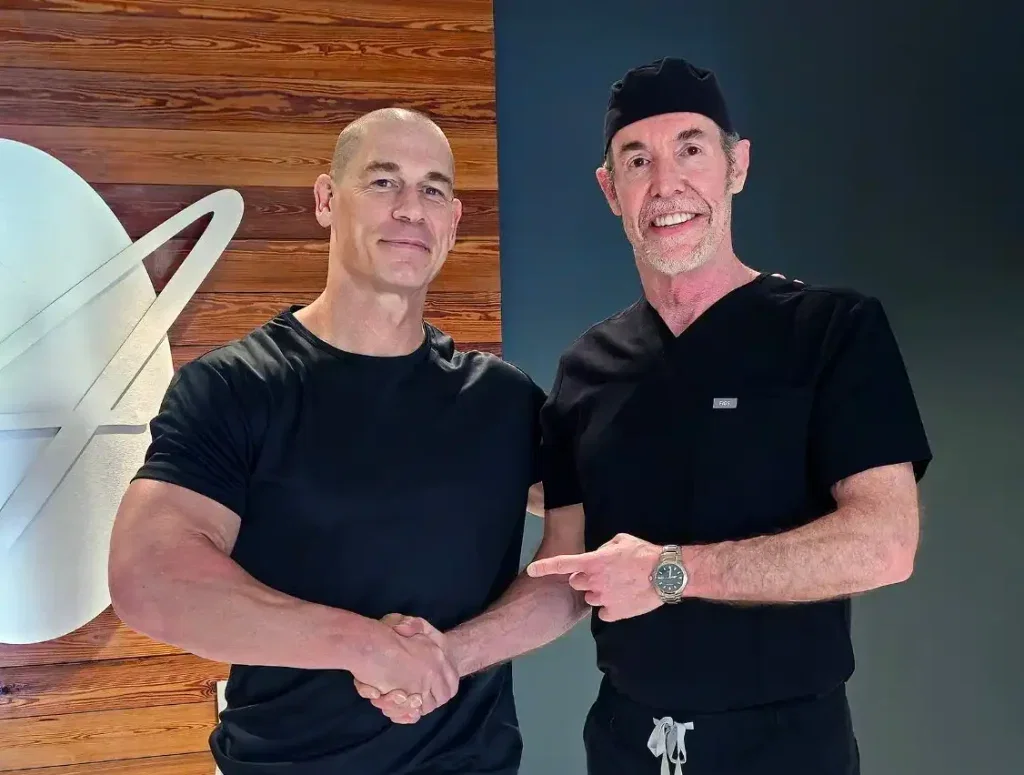
John Cena has never been shy about his hair restoration journey, and this week he took transparency to a new level. On June 29, the retired WWE legend and Hollywood actor posted a photo of himself completely bald, shaking hands with hair restoration surgeon Dr. Ken Anderson at the Anderson Center for Hair in Atlanta. The caption: “Round 2 of FUE Treatment and this time I went all in for best possible results.”
The image caught fans off guard — a fully shaved John Cena is not something the world sees often — but the story behind it is one that thousands of hair transplant patients will recognize. Cena, 49, underwent his first FUE (Follicular Unit Extraction) procedure with the same clinic in late 2024, pairing it with a maintenance routine of minoxidil, red-light therapy, vitamins, and specialized shampoos. Now he’s back for a second session, and his decision to shave his head entirely, something not strictly required for the procedure, was, in his words, about maximizing the outcome.
So what makes a second transplant different from the first? Quite a lot, actually.
Why patients come back for a second procedure
A second transplant isn’t a sign the first one failed. In many cases, it’s part of the plan from day one. Surgeons often stage treatment deliberately: the first session restores the hairline and frontal zone, where results have the biggest visual impact, while a second session adds density or addresses the crown. Other patients return because hair loss is progressive. A transplant relocates permanent hair, but it doesn’t stop native hair around it from continuing to thin. Cena himself has been candid that his goal is simply to stay ahead of a receding hairline, not to reverse time overnight.
What’s different the second time around
The single biggest consideration in a repeat procedure is the donor area. Every person has a finite supply of transplantable follicles, typically from the back and sides of the scalp. A portion of that reserve was used in the first session, so the surgeon must harvest more strategically the second time, working around previously extracted zones and any micro-scarring left behind. This is precisely why experienced surgeons “bank” donor hair conservatively in a first procedure. They’re planning for the possibility of a round two.
Placement is also more delicate. New grafts must be implanted between existing transplanted hairs without damaging them, and the surgeon has to match angles, direction, and density so the two sessions blend into one natural result. Cena’s choice to shave fully, while optional with modern techniques, gives the surgical team maximum visibility for exactly this kind of precision work.
Timing matters too. Most clinics recommend waiting at least 10 to 12 months between sessions, since transplanted hair takes close to a year to fully mature. Operating too soon means working blind as the surgeon can’t yet see where the first procedure’s density has settled.
Success rates and risks
The good news: second transplants performed by qualified surgeons enjoy graft survival rates comparable to first procedures, generally cited in the 90%+ range when donor hair is healthy and the recipient area has good blood supply. Scar tissue from a prior session can slightly complicate extraction and implantation, but in experienced hands it rarely compromises the outcome.
The risks are mostly familiar ones: temporary “shock loss” of surrounding hairs, swelling (Cena joked after his first procedure that healing left him with “an alien head”), and the usual small risks of infection or poor growth. The risk unique to repeat procedures is donor depletion: harvest too aggressively and the back of the head can start to look visibly thinned, with little reserve left for the future. This is why candid planning conversations about long-term hair loss expectations are even more important before a second session than before a first.
The bigger picture
Perhaps the most valuable part of Cena’s post isn’t medical at all. Here is one of the most famous men on the planet openly documenting a repeat procedure — bald photo and all — after previously saying he wished he’d done it a decade earlier if not for the stigma. For the estimated two-thirds or more of men who experience noticeable hair loss, that kind of openness makes it easier to research options, ask questions, and choose a qualified clinic without embarrassment.
Round 2 is underway. Based on how transplants mature, expect to see the full results of Cena’s “all in” bet sometime in mid-2027.