
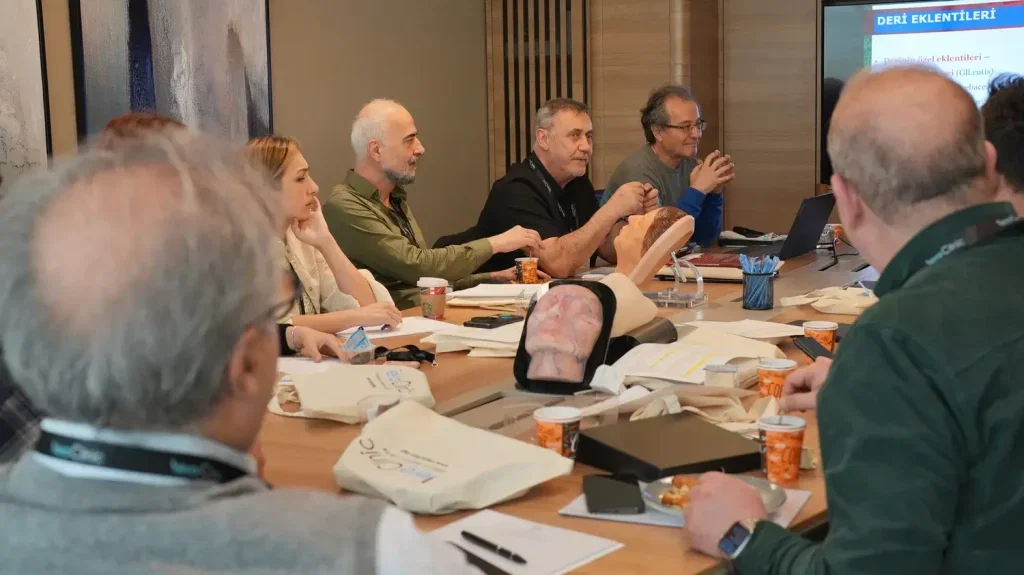
Most patients know Vera Clinic as an Istanbul hair transplant hospital. We also run Vera Clinic Academy, a division that trains licensed physicians and studies how our patients do after surgery.
What the Academy is
Vera Clinic Academy is our research and training arm. Our training programs are approved by the Turkish Ministry of Health and the Ministry of National Education, so graduates receive Ministry-issued certification. The Academy also runs a clinical research program based on our own patient data.
Dr. Hamit Göz leads training. Dr. Emin Gül reviews the Academy’s content and research.
Physician training
Our main program is a four-week hair transplantation course for licensed physicians. It covers local anesthesia, PRP and low-level laser therapy, DHI and FUE extraction, donor-area management, and the use of sapphire blades, steel blades and punches. Classroom teaching is combined with supervised hands-on practice, and graduates receive a Ministry-approved Hair Transplant Practitioner Certificate.
We also offer a one-week program in facial cosmetic procedures. Both courses include guest lecturers from outside institutions such as Cerrahpaşa, and a licensed psychologist teaches a module on patient psychology and communication. All twelve places in our first cohort were filled.
Our research program
We use our own clinical database to study the psychological, physiological and surgical outcomes of hair transplantation. Completed and ongoing studies include:
- Graft survival over time: measurements at 12 and 24 months, plus a five-year follow-up cohort.
- Survival by patient profile: graft outcomes across Norwood stages (n=1,050) and by hair characteristics.
- Safety and recovery: a complication and side-effect registry (n=690) and a study of early healing with OxyCure hyperbaric oxygen therapy (n=71).
- Patient experience: a study of needle-free anesthesia and procedural pain, and a study of psychological well-being after transplantation (n=40).
The program currently includes around thirty studies.
Our Hair Transplant Statistics report
The most useful single resource we produce for patients is our Hair Transplant Statistics report. It brings together data from the ISHRS Practice Census, the Turkish Ministry of Health, market research firms, peer-reviewed clinical literature and the Vera Academy Clinical Database in one place.
The report covers:
- The global market: market size, annual procedure volume and a regional breakdown.
- Turkey’s role: the country performed an estimated 1.1 to 1.5 million procedures in 2025, about a quarter to a third of global volume.
- Technique comparisons: side-by-side statistics for FUE, Sapphire FUE, Vector-10 CVD FUE, DHI, robotic, stem cell and PRP/adjunctive treatments.
- Costs: price per graft and full-procedure costs in Turkey compared with the US, UK and other markets, plus how patients pay.
- Patients and outcomes: global patient demographics, success and satisfaction rates, and trends such as AI planning, female hair transplants, telemedicine and regulation.
We version and update the report on a regular schedule, with a version log, methodology notes and a full source list. We also publish companion statistics pages for specific procedures, including FUE, DHI, female hair transplants and eyebrow transplants.
If you’re comparing techniques, countries or prices before booking a consultation, it’s a good place to start.
The Vector-10 diamond blade study
Our most recent published work looks at the blade used to open recipient sites, the small channels into which grafts are placed. In March 2026, we introduced the Vector-10, a recipient-site blade made from CVD (chemical vapor deposition) lab-grown diamond. We evaluated it in two parts: independent laboratory testing of how long the edge stays sharp, and a six-month follow-up of the first 30 patients we treated with it.
Why blade wear matters
A hair transplant involves thousands of incisions made one at a time in a single session. Each one sets the depth and angle at which a graft will grow. As a blade dulls, it needs more force to open the same channel, and that extra pressure is absorbed by the surrounding scalp tissue.
The effect is largest in big procedures. Patients with advanced hair loss need the most grafts and the longest sessions, so their final incisions are made after the blade has had the most time to wear.
Recipient-site blades have gone through three main materials:
| Blade material | Hardness (Mohs) | Incision profile | Introduced in FUE |
| Stainless steel | ~5.5 | U-shaped | First generation |
| Synthetic sapphire | 9 | V-shaped | 2017 |
| CVD lab-grown diamond (Vector-10) | 10 | V-shaped, Ångström-scale edge radius | 2026 |
Sapphire brought the change from a U-shaped to a V-shaped incision. Diamond keeps the V-shaped profile; the gain we were looking for is in how long the edge lasts.
Laboratory results
We commissioned Çınar Validation and Test Laboratories (CinarLabs) to measure the force each blade needed to cut a standardized test material as the number of uses increased. Lower force indicates a sharper edge. The main results:
- At 1,000 incisions, the diamond blade was twice as sharp as sapphire.
- At 3,000 incisions, roughly the length of a full session, the diamond blade needed about 38% less force than sapphire. Compared with when it was new, the diamond blade needed about 7% more force, while sapphire needed about 15% more.
- Over long-term use, sapphire’s sharpness after 6,000 uses matched diamond’s after 90,000 uses, about 15 times the durability. The diamond blade completed 150,000 uses without structural damage.
The 3,000-incision figures matter most for surgery, since they describe the blade’s condition at the end of a typical session.
Patient results at six months
We followed 30 patients operated on in March 2026, the blade’s first month in clinical use. Patients received an average of 2,880 grafts, close to the 3,000-incision mark tested in the lab. The same senior hair transplant doctor and surgical team performed every procedure.
To measure graft retention, our team marked a fixed area of the scalp during each operation and compared it with photographs of the same area taken six months later. Patients took the follow-up photographs at home with live guidance from our post-operative care team over video call.
Average graft survival at six months was 94.4%. Patients with Norwood V hair loss, who needed the most incisions, averaged 92.0%. No patient needed a second surgery.
“In a long session, the last incision matters as much as the first,” says Dr. Emin Gül. “These early six-month figures offer a useful baseline.”
Transplanted follicles continue to mature for 12 to 18 months, and we will report 12-month results for the same patients.
What it means for patients
A blade that holds its edge lets our surgeons open the last recipient sites of a long session with close to the same precision as the first. That matters for even density from hairline to crown, and lower cutting force means less trauma to the scalp around each graft. At Vera Clinic, our doctors open the recipient channels themselves.
If you’re comparing clinics, ask which blade material they use for recipient sites, how many incisions your procedure will involve, and whether they track their own graft survival.
Why it matters
Our training program is certified against a Ministry standard, and our research program publishes outcome data on our own patients, with several longer follow-ups still in progress. We think prospective patients should be able to see how a clinic trains its doctors and how its patients actually do, and the Academy is how we make that available.
This post is published as sponsored Clinic Update content supplied by Vera Clinic. The views and claims are the clinic’s own.

2 locations in Istanbul
Vera Clinic, open since 2013, is where five doctors perform Sapphire FUE and DHI hair transplants in Istanbul, with fixed-price packages including hotel stay and transfers.