Hair Transplant Frequently Asked Questions

Considering a hair transplant is a big decision, and it’s natural to have questions about the procedure, costs, recovery, and results. We’ve compiled answers to the most common questions people ask when researching hair restoration options to help you make an informed choice. Whether you’re just beginning to explore hair transplants or ready to find a qualified hair transplant clinic, these answers to frequently asked questions will give you the essential information you need.

What is a hair transplant and how does it work?
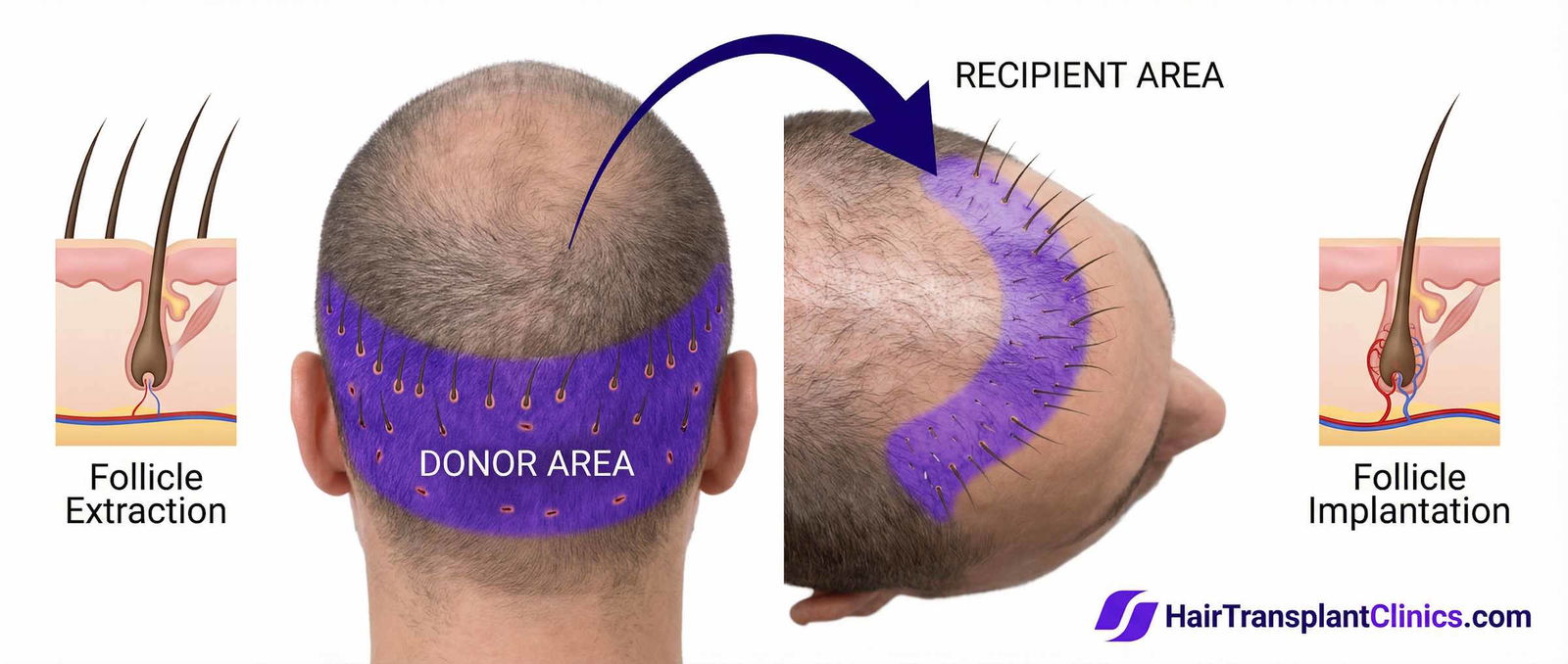
Hair Transplant DiagramA hair transplant is a surgical procedure that permanently relocates hair follicles from areas of your scalp where hair grows abundantly to areas experiencing thinning or baldness. The procedure works on a simple but powerful principle: hair follicles taken from the back and sides of your head are genetically programmed to resist balding, and they maintain this resistance even when moved to other areas.

During the procedure, a surgeon extracts healthy hair follicles from your donor area and carefully implants them into tiny incisions in the balding regions. These transplanted follicles establish a new blood supply in their new location and continue their natural growth cycle. The result is permanent, natural-looking hair growth that you can wash, cut, style, and treat just like your original hair. Most patients see initial growth within a few months, with full results visible after about a year.

The three main hair transplant techniques are FUT, FUE, and DHI, each with distinct advantages. FUT, or Follicular Unit Transplantation, involves removing a strip of scalp from the donor area, which is then dissected into individual follicular units for transplantation. This method can harvest a large number of grafts in a single session and is often more cost-effective, but it does leave a linear scar that may be visible with very short hairstyles.
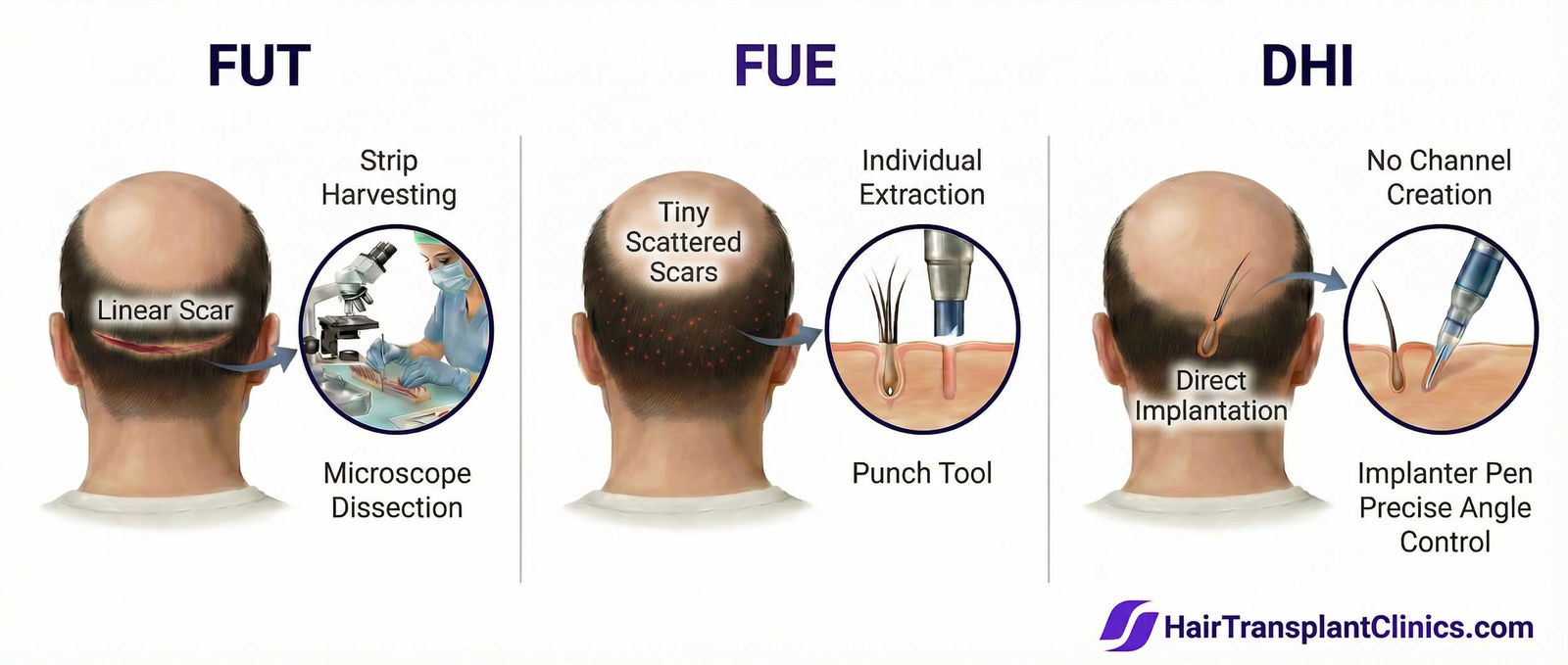
A Comparison of FUE, FUT and DHI Hair Transplantation Techniques

FUE, or Follicular Unit Extraction, has become increasingly popular because it extracts individual follicles one by one using a small punch tool. This technique leaves only tiny, scattered scars that heal quickly and are virtually undetectable, making it ideal for patients who prefer short haircuts. DHI, or Direct Hair Implantation, is a refined variation of FUE where follicles are implanted immediately after extraction using a specialized pen-like device, allowing for precise control over the angle and direction of each hair. Your surgeon will recommend the best technique based on your hair characteristics, the extent of your hair loss, and your aesthetic goals.

Hair transplant costs in the United States generally range from $4,000 to $15,000, with most patients paying between $7,000 and $12,000 for their procedure. The price depends on several factors including the number of grafts you need (typically charged at $3 to $10 per graft), the technique used, the surgeon’s experience and reputation, and your geographic location. FUE procedures tend to cost more than FUT because they’re more time-intensive, and clinics in major metropolitan areas typically charge premium prices.

International options, particularly in Turkey, Mexico, and Eastern Europe, can offer significantly lower prices ranging from $2,000 to $5,000 for comparable procedures. However, traveling abroad for surgery requires careful research to ensure the clinic meets proper safety and quality standards. It’s important to remember that hair transplants are almost always considered cosmetic procedures, so insurance won’t cover the cost. Many clinics offer financing plans to make the procedure more accessible, but be cautious of prices that seem unrealistically low—quality results require skilled surgeons, proper facilities, and sterile techniques.

The ideal hair transplant candidate has a stable pattern of hair loss, sufficient healthy donor hair on the back and sides of the scalp, and realistic expectations about what the procedure can achieve. Good candidates are typically experiencing male or female pattern baldness rather than hair loss from medical conditions, have good overall health that supports proper healing, and understand that results take time to develop fully. Age matters too—it’s generally better to wait until your hair loss pattern has stabilized, which is why surgeons often recommend waiting until your late twenties or early thirties unless hair loss is severe.

You may not be a suitable candidate if you have insufficient donor hair, unpredictable hair loss patterns, certain medical conditions that impair healing like uncontrolled diabetes or bleeding disorders, or a tendency to develop keloid scars. Hair loss caused by autoimmune conditions like alopecia areata or temporary factors like stress or nutritional deficiencies typically doesn’t respond well to transplantation. The only way to know for certain is through a consultation with a qualified hair transplant surgeon who can examine your scalp, evaluate your hair loss pattern, assess your donor hair quality, and discuss whether a transplant can achieve your goals.

Hair Transplant Surgery Recovery Timeline

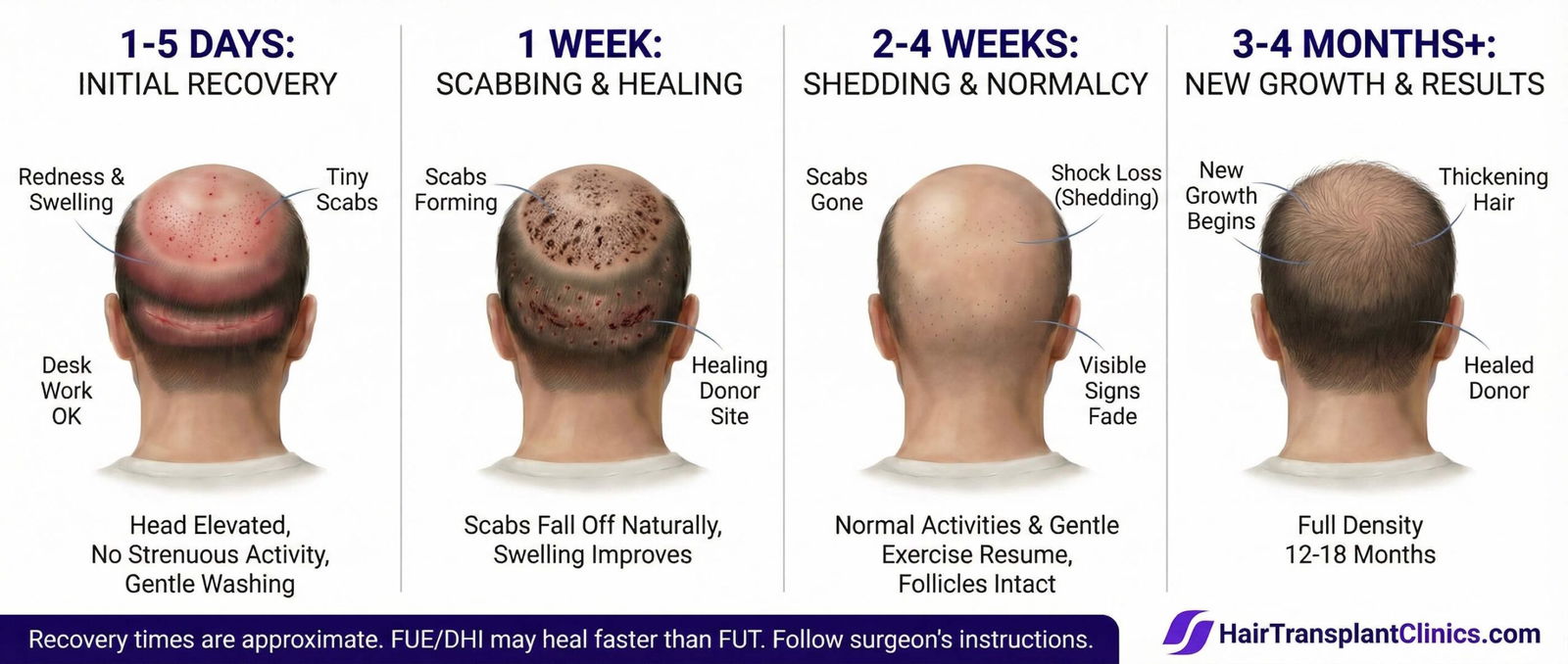
Most hair transplant patients can return to desk work within three to five days, though you’ll need to avoid strenuous activities for about two weeks. The first week involves some redness, swelling, and scabbing at both the donor and recipient sites, which gradually improves as the scabs fall off naturally after seven to ten days. During this time, you’ll need to sleep with your head elevated, avoid bending over or any activities that increase blood pressure, and follow your surgeon’s specific washing instructions to protect the newly transplanted grafts.

By the second to fourth week, most visible signs of the procedure fade and you can resume normal activities including gentle exercise. Don’t be alarmed if your transplanted hairs shed during this period—this “shock loss” is completely normal and expected. The transplanted follicles remain intact beneath the skin and will start producing new growth around month three or four. FUE typically offers a slightly faster initial recovery than FUT, and DHI may heal the quickest of all. Full results gradually develop over twelve to eighteen months as the transplanted hair grows, thickens, and reaches its maximum density.

Hair transplant results are permanent because the transplanted follicles come from areas of your scalp that are genetically resistant to the hormone DHT, which causes pattern baldness. When these follicles are moved to thinning areas, they retain their original characteristics and continue producing hair for your lifetime. You can treat this transplanted hair exactly like your natural hair—washing, cutting, coloring, and styling it without any special considerations.

However, it’s important to understand that while the transplanted hair itself is permanent, your native non-transplanted hair may continue to thin over time due to ongoing pattern baldness. This means you might need additional procedures in the future to address further hair loss in other areas, or you may choose to use medications like finasteride or minoxidil to help preserve your existing hair. The permanence of your results also depends on proper surgical technique—poorly handled grafts can fail to thrive, which is why choosing an experienced surgeon is crucial for long-lasting outcomes.

Most patients are pleasantly surprised by how little pain they experience during a hair transplant. The procedure itself is performed under local anesthesia, so you’ll feel pressure and tugging but no significant pain while the surgeon works. The initial anesthetic injections cause brief stinging, though many modern clinics now use advanced “painless anesthesia” techniques that minimize even this discomfort. Some patients choose light sedation if they’re particularly anxious, but many simply listen to music or watch videos during the procedure.

After the surgery, you can expect mild to moderate tenderness for two to four days, which most patients describe as manageable discomfort rather than severe pain. Your surgeon will prescribe pain medication for the first few days, after which over-the-counter pain relievers are usually sufficient. The donor area typically causes more discomfort than the recipient area, and FUT (strip method) generally involves more post-operative tenderness than FUE. Sleeping in an upright position and following your surgeon’s aftercare instructions helps minimize any discomfort. Overall, the anticipation of pain is often worse than the actual experience.

Modern hair transplants have excellent success rates. 90 to 95 percent of transplanted grafts typically survive and produce permanent hair growth when the procedure is performed by an experienced surgeon. However, success isn’t just about graft survival. It’s also about achieving natural-looking, aesthetically pleasing results that meet your expectations. Patient satisfaction rates are similarly high, with 85 to 95 percent of patients reporting they’re happy with their outcomes, though this depends heavily on having realistic expectations from the start.

Several factors influence success rates beyond just surgical technique. Your individual hair characteristics like color, texture, and density play a significant role in how natural and full the results appear. The number of grafts transplanted relative to the area being covered affects density, and your commitment to following pre- and post-operative instructions impacts healing and graft survival. Using medications like finasteride or minoxidil to preserve your existing non-transplanted hair can also improve long-term satisfaction. The most important factor in ensuring success is choosing a experienced surgeon with a proven track record. Poor technique, rough graft handling, or inadequate artistic planning can significantly compromise results regardless of how many grafts survive.

Hair transplants are generally safe procedures when performed by qualified surgeons, but like any surgery, they do carry some risks. The most common side effects are temporary and include swelling of the scalp and forehead that subsides within a few days, itching during the healing process, temporary numbness in treated areas, and scabbing that naturally resolves within a week or two. Many patients also experience “shock loss,” which is temporary shedding of existing hair near the transplant site. This is normal and the hair typically grows back.

Less common but possible complications include infection (rare with proper sterile technique), minor bleeding, visible scarring if the procedure is poorly executed, small cysts where follicles were implanted, and folliculitis or inflammation of hair follicles that responds well to antibiotics. Aesthetic risks are perhaps the most concerning for patients and include unnatural-looking hairlines from poor design, a “pluggy” or outdated appearance, visible scarring from inadequate technique, or irregular density across the transplanted area. Serious complications like severe infection, excessive bleeding, or nerve damage are very rare but possible.

The best way to minimize all these risks is to choose an experienced hair transplant surgeon with extensive before-and-after photos you can review, follow all pre- and post-operative instructions carefully, disclose your complete medical history including medications and supplements, and attend all scheduled follow-up appointments. Taking time to thoroughly research your surgeon is the single most important step in avoiding complications and ensuring a successful outcome.

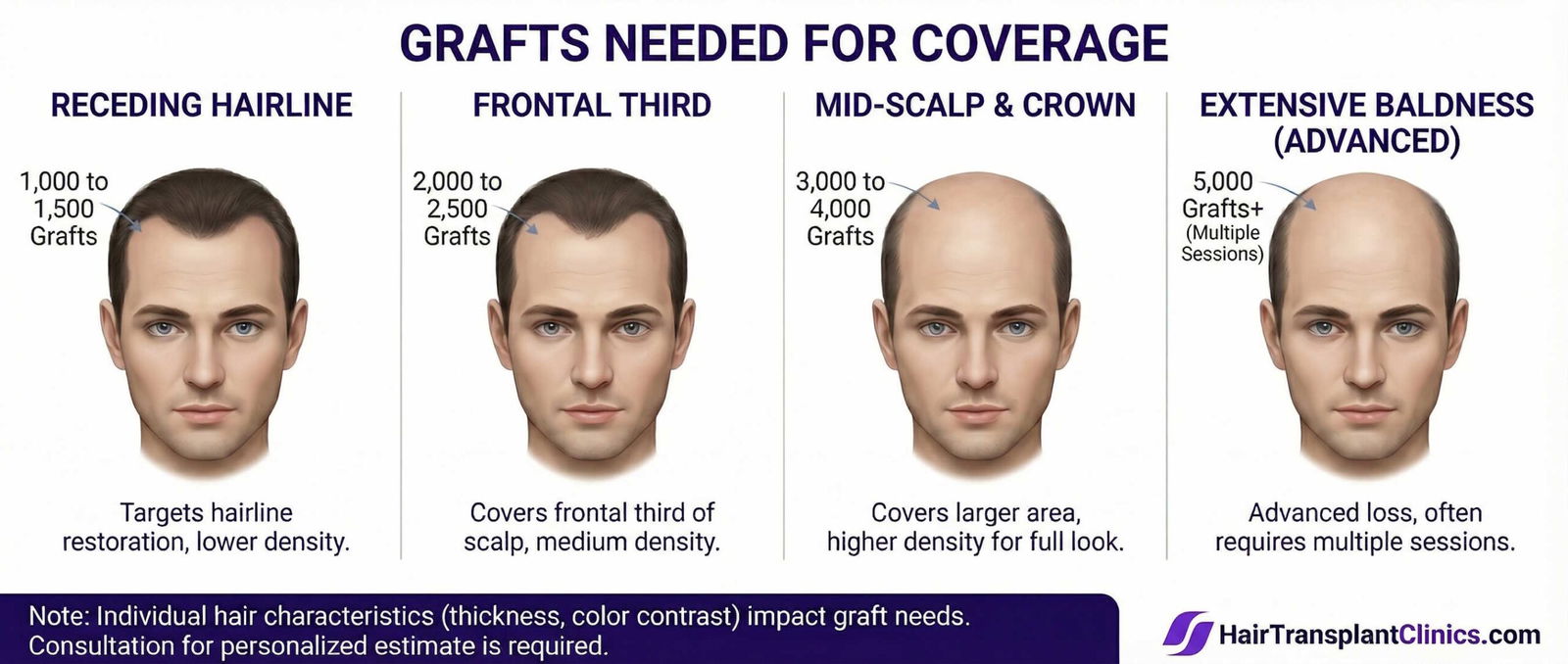
How Many Grafts Are Needed for a Hair TransplantThe number of grafts you’ll need depends on the size of the area you want to cover, your desired density, and your hair characteristics. As a general guideline, restoring a receding hairline might require 1,000 to 1,500 grafts, treating the frontal third of the scalp typically needs 2,000 to 2,500 grafts, and covering more extensive baldness across the mid-scalp and crown can require 3,000 to 4,000 grafts or more. Some patients with advanced hair loss may need multiple sessions totaling 5,000 grafts or beyond to achieve their goals.

Your individual hair characteristics significantly impact how many grafts you’ll need. People with thick, coarse hair or hair that closely matches their scalp color can achieve good coverage with fewer grafts than someone with fine, thin hair or high contrast between their hair and skin color. The quality and density of your donor hair also determines how many grafts can safely be harvested without leaving the donor area looking depleted. During your consultation, a surgeon will examine your scalp, discuss your goals, and provide a personalized estimate. Keep in mind that trying to maximize density by packing too many grafts into an area can actually damage existing follicles and reduce overall results, so experienced surgeons balance your goals with what’s medically and aesthetically optimal.

Finding the best hair transplant clinic requires careful research. Start by looking for board-certified surgeons who specialize specifically in hair restoration. This is a highly specialized field, and you want someone who performs these procedures regularly, not a general cosmetic surgeon who does occasional hair transplants. Check their credentials, years of experience, and whether they’re members of professional organizations like the International Society of Hair Restoration Surgery. Reviews and testimonials from previous patients can provide valuable insights, but pay attention to detailed reviews that discuss the entire experience rather than just star ratings.

Request to see extensive before-and-after photos of the surgeon’s actual patients, ideally showing results at various stages of healing and from multiple angles. Be wary of clinics that only show perfect cases or use stock photos. The consultation itself is an important evaluation opportunity. A good surgeon will thoroughly examine your scalp, discuss realistic expectations, explain which technique they recommend and why, and never pressure you into scheduling surgery immediately. Pay attention to the clinic’s cleanliness, the staff’s professionalism, and whether the surgeon takes time to answer all your questions. Price shouldn’t be your primary deciding factor, but extremely low prices compared to other qualified surgeons in your area should raise red flags about corners being cut on quality, safety, or the surgeon’s actual experience level.

When evaluating hair transplant clinics, the surgeon’s qualifications and experience should be your top priority. Look for board certification in dermatology or plastic surgery, specific training and extensive experience in hair restoration techniques, and membership in recognized professional organizations. A surgeon who has performed thousands of procedures and focuses exclusively or primarily on hair transplants will typically deliver better results than someone who does them occasionally alongside other cosmetic procedures.

The clinic’s facility and practices matter just as much as the surgeon’s credentials. The operating environment should be clean, professional, and equipped with modern technology for both FUT and FUE procedures. Ask whether the surgeon personally performs every critical step of your procedure or whether technicians handle portions of the surgery. Some clinics use a team approach which can be fine if properly supervised, but you want to know exactly who will be creating your hairline, extracting grafts, and implanting follicles. Request to see comprehensive before-and-after photo galleries of actual patients with similar hair loss patterns to yours, and ask if you can speak with previous patients about their experiences. Finally, trust your instincts during the consultation. A reputable hair transplant clinic will never rush you into a decision, will honestly discuss what’s achievable given your specific situation, and will make you feel comfortable and informed throughout the process.

During your consultation, ask detailed questions about the surgeon’s experience and qualifications, including how many hair transplant procedures they’ve performed, what percentage of their practice is dedicated to hair restoration, and which technique they recommend for your specific case and why. Don’t hesitate to ask about their complication rates and how they handle unsatisfactory results or complications if they occur. Request to see before-and-after photos of patients with similar hair loss patterns, hair type, and age to yours, and ask if these results are typical or exceptional cases.

You should also discuss the specifics of your procedure, including how many grafts the surgeon estimates you’ll need, what density you can realistically expect to achieve, whether you’ll need multiple sessions, and what the total cost will be including any follow-up procedures. Ask who will perform each step of your surgery—the extraction, recipient site creation, and implantation—and clarify whether the quoted price includes all post-operative care and follow-up appointments. Questions about the recovery process, when you can return to work and exercise, what medications you’ll need, and what the timeline is for seeing results will help you plan accordingly. Finally, ask about their policy on revisions or touch-ups, and whether they recommend any complementary treatments like medications or PRP therapy to optimize your results and preserve your existing hair.

Yes, women can absolutely get hair transplants, though female hair loss patterns often differ from male pattern baldness, which affects the approach and candidacy. Women typically experience diffuse thinning across the top of the scalp rather than a receding hairline or bald crown, and they usually maintain their frontal hairline. This diffuse thinning pattern can actually make women excellent candidates for hair transplants because they often have adequate donor hair in the back and sides of the scalp, and strategic transplantation can significantly improve overall density and coverage.

However, determining candidacy in women requires careful evaluation because hair loss in women can result from various causes including hormonal changes, thyroid disorders, nutritional deficiencies, autoimmune conditions, or traction from tight hairstyles. A good surgeon will want to identify the underlying cause of hair loss before recommending a transplant, as some conditions respond better to medical treatment than surgery. Women with androgenetic alopecia (female pattern hair loss) who have stabilized hair loss and adequate donor hair are typically excellent candidates. The results can be particularly natural-looking in women because the transplanted hair blends seamlessly with existing hair, and women often have the advantage of being able to style their hair in ways that enhance coverage during the growth phase.

Age is an important consideration for hair transplants, though there’s no absolute cutoff on either end. Being too young is generally more of a concern than being too old. Most reputable surgeons are cautious about performing hair transplants on men under 25 because hair loss patterns haven’t fully established themselves yet. Having a transplant too early can lead to unnatural-looking results as continued hair loss creates a patchwork appearance, or it can waste valuable donor hair that might be better used to address more extensive balding later in life. That said, some younger patients with aggressive hair loss and strong family history may be good candidates if their pattern has clearly stabilized and they understand they’ll likely need additional procedures as they age.

On the upper end, there’s no specific age that’s too old for a hair transplant as long as you’re in good health and can safely undergo the procedure. Many patients in their 60s and 70s successfully undergo hair transplants with excellent results. The key factors are your overall health, your ability to heal properly, the quality and quantity of your donor hair, and your realistic expectations about outcomes. Older patients often have the advantage of a fully established hair loss pattern, so surgeons can create a comprehensive long-term plan. Some older patients may have thinner donor hair or reduced density, which could limit the number of grafts available, but this doesn’t necessarily rule out the procedure. A thorough consultation with an experienced surgeon will determine whether age is a factor in your specific case.

Choosing between a domestic and international hair transplant clinic involves weighing cost savings against convenience, quality assurance, and potential risks. International clinics, particularly in Turkey, Mexico, Thailand, and Eastern Europe, often offer procedures at 50 to 70 percent lower prices than US clinics, which can make hair transplants accessible to patients who couldn’t otherwise afford them. Some of these international clinics are world-class facilities with highly experienced surgeons who perform dozens of procedures weekly, offering excellent results and comprehensive packages that include accommodation and transportation. Medical tourism for hair transplants has become a well-established industry in certain countries.

However, traveling abroad for surgery requires more extensive research and carries additional considerations. You’ll need to verify the surgeon’s credentials, training, and experience since regulatory standards vary by country, and it’s harder to assess quality from a distance. Communication barriers, different medical standards and sterilization protocols, limited legal recourse if something goes wrong, and the challenge of attending follow-up appointments are all important factors to consider. If complications arise after you return home, you’ll need to find a local surgeon willing to address issues from another doctor’s work, which isn’t always easy. Domestic clinics offer the advantage of easier verification of credentials, consistent regulatory oversight, straightforward communication, convenient follow-up care, and legal protections if problems occur. Many patients find the peace of mind and accessibility of aftercare worth the higher cost, while others successfully navigate medical tourism with thorough research and careful clinic selection. The key is being honest about your priorities and doing comprehensive due diligence regardless of where you choose to have your procedure.

Several alternatives to hair transplants exist, ranging from medical treatments to cosmetic solutions, each with different levels of effectiveness and commitment. The most proven medical treatments are finasteride (Propecia), a prescription pill that blocks the hormone DHT responsible for hair loss, and minoxidil (Rogaine), a topical solution applied directly to the scalp. Finasteride can slow or stop hair loss in about 80 to 90 percent of men and even regrow some hair in many cases, though it requires ongoing daily use to maintain results and isn’t suitable for women of childbearing age. Minoxidil works for both men and women and can stimulate some regrowth, though it’s generally more effective at slowing loss than producing dramatic new growth. Both treatments require indefinite continuation—stopping them means losing any benefits gained.

Newer treatments like low-level laser therapy (LLLT) using special caps or combs, platelet-rich plasma (PRP) injections that use your own blood components to stimulate follicles, and medications like dutasteride show promise but have varying levels of scientific support. For those not ready for medical intervention, cosmetic solutions include hair systems or wigs that have become increasingly natural-looking and comfortable, scalp micropigmentation which tattoos tiny dots on the scalp to simulate the appearance of a buzz cut or add density, and hair fibers or sprays that temporarily camouflage thinning areas. Lifestyle changes like managing stress, eating a nutrient-rich diet, avoiding harsh hair treatments, and addressing underlying health issues can help slow hair loss, though they rarely reverse it. Many patients find that combining approaches, such as using finasteride to preserve existing hair while getting a transplant to restore lost areas, provides the best long-term results. A consultation with a hair loss specialist can help you determine which combination of treatments makes sense for your situation, goals, and budget.